
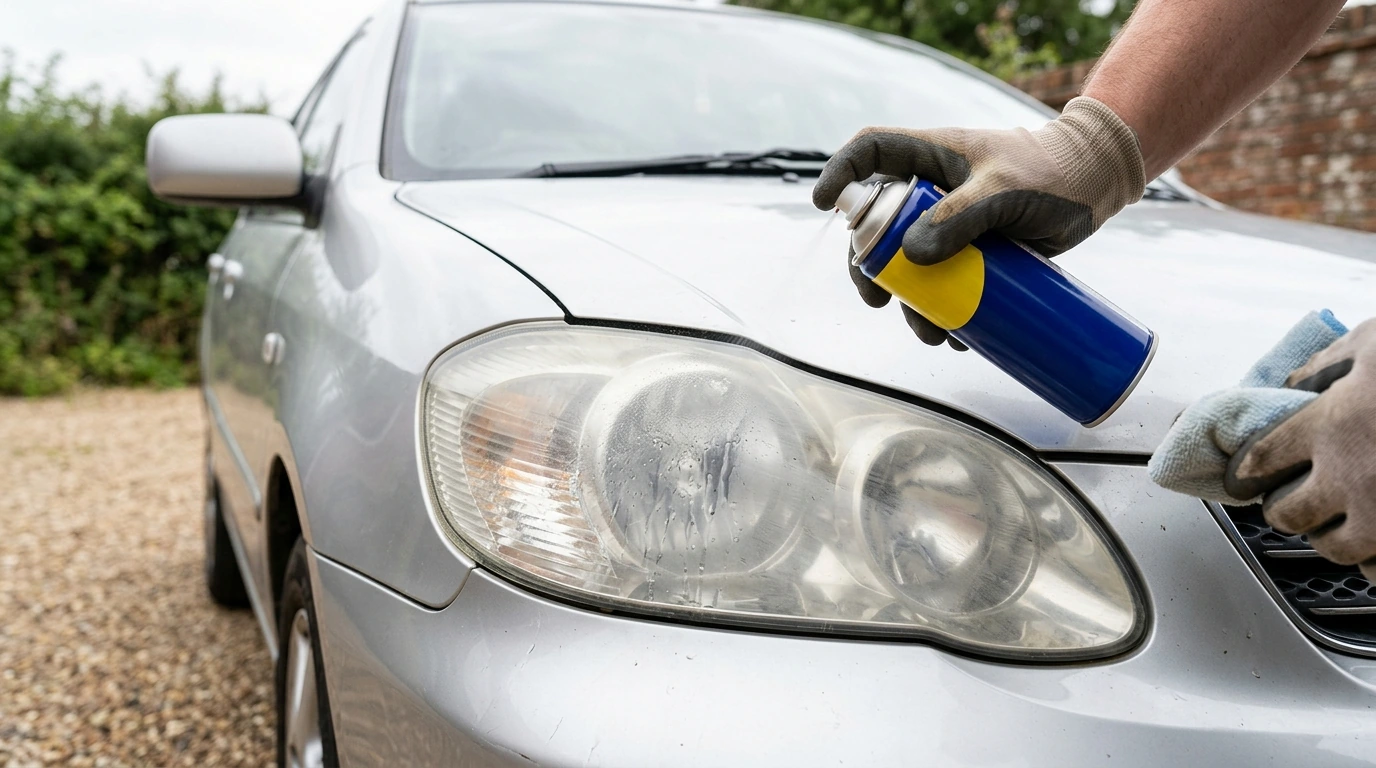
WD-40 can make foggy headlights look clearer fast, but it’s not a true fix. It works mainly as a temporary cosmetic improvement: the oils can fill in tiny surface imperfections and make the plastic look more transparent for a short time. If your lenses are cloudy from oxidized polycarbonate (the most common cause), the haze will usually return once the product evaporates or washes away.
Most “foggy” headlights are covered in a chalky, oxidized layer where the factory UV-protective coating has broken down. WD-40 can briefly darken and wet that dull layer, making it appear clearer. It does not remove oxidation in a controlled way, and it does not replace the UV barrier that keeps the lens from re-clouding.
If your headlights are only mildly dull and you need a short-lived improvement before a drive, WD-40 may improve appearance. But if the lens feels rough, looks yellow, or has visible cracking/crazing, WD-40 won’t correct the underlying damage. In those cases, you’ll get better results from a proper restore-and-seal approach.
For clarity that lasts, our team recommends cleaning the lens, removing oxidation with a controlled abrasive (often wet sanding followed by polishing), then sealing the surface with a UV-protective coating. This restores transparency and helps prevent the haze from returning quickly. For a step-by-step checklist and product guidance, use our full DIY guide here: DIY Headlight Rescue: Clean Cloudy Headlights Checklist.
If you use WD-40, keep it off paint and rubber trim by masking the area first, then wipe any overspray immediately. Apply a small amount to a microfiber cloth (not directly to the lens), wipe evenly, and buff dry so the surface isn’t left oily. Treat it as a short-term stopgap—not a restoration.
After restoring clarity, apply a UV-resistant sealant or coating and keep the lens clean. Regular washing and occasional reapplication of UV protection helps slow oxidation.












Leave a comment