
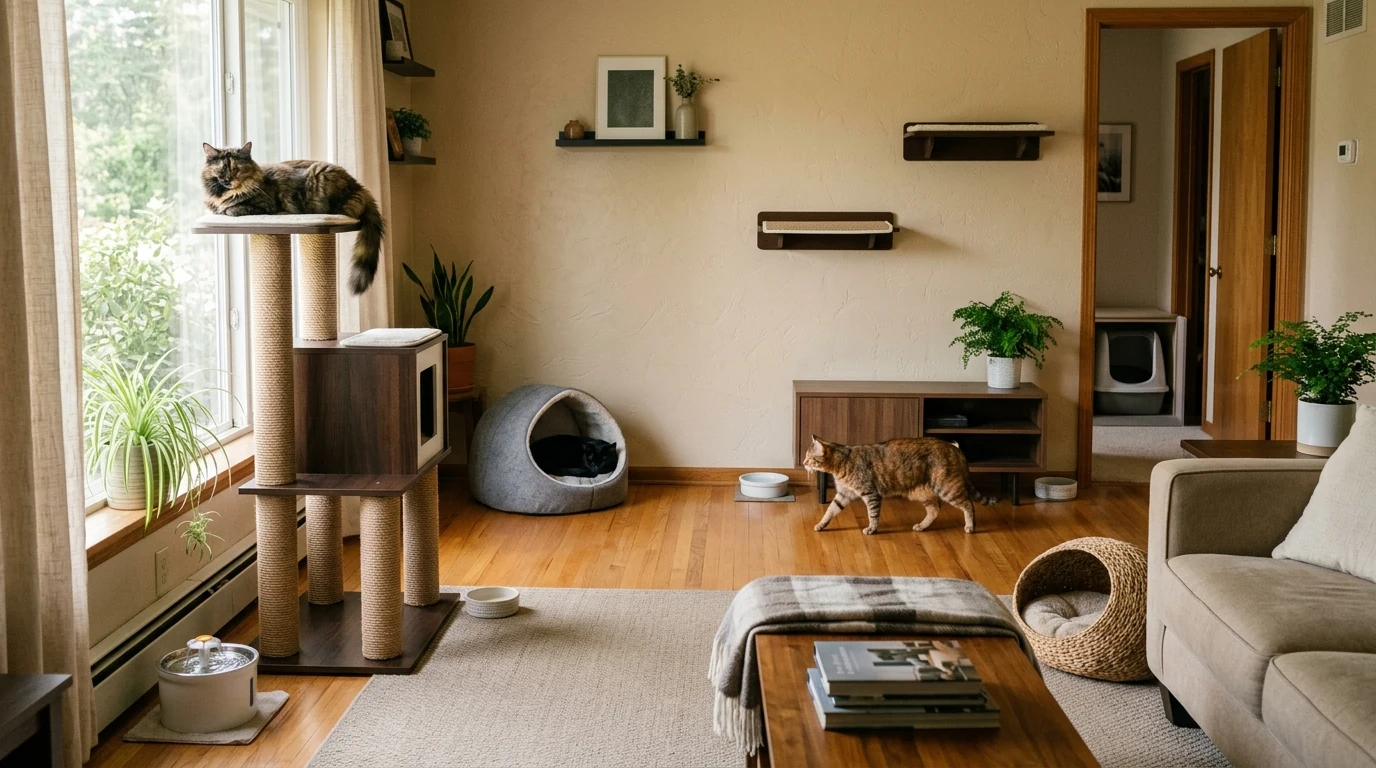
Territory conflicts can turn a calm home into a stressful one for both cats and people. With the right setup and routines, most multi-cat tension can be reduced by meeting cats’ needs for space, safety, and predictable access to key resources—without forcing them to “work it out.” The goal is simple: fewer ambush opportunities, more choices, and calmer daily patterns that help cats feel secure.
For cats, “territory” is less about owning the whole house and more about controlling access to what matters most: food, water, litter, resting spots, preferred routes, and human attention. Many cats create “core areas” (high-value zones like a favorite bed, window, or quiet room) and “travel lanes” (the paths they prefer to move through without being challenged).
Scent and routine matter as much as physical space. When furniture moves, a new pet arrives, a family member changes schedules, or an outdoor cat starts appearing at the window, the scent map and predictability of the home can feel “wrong,” which can trigger renewed guarding behaviors or tension that seems to come out of nowhere.
Not all conflict looks like a full-on brawl. Many households deal with “quiet pressure” that still harms a cat’s wellbeing.
For deeper background on how multi-cat stress shows up, the American Association of Feline Practitioners (AAFP) behavior guidelines are a reliable reference.
Walk through your home at “cat level.” Look for places where cats are forced into close contact, especially around essentials. Common bottlenecks include narrow hallways, single staircases, doorways to food/litter areas, and tight corners that don’t allow a cat to pass without being seen.
When possible, create at least two routes to essentials (for example, two approaches to the litter area). Add vertical options such as cat trees, shelves, and window perches so one cat can pass without a face-to-face confrontation. Finally, make sure each cat has at least one protected resting spot that can’t be approached from behind—this alone can reduce “always on guard” tension.
| Area | Risk Signal | Practical Fix |
|---|---|---|
| Litter box zone | Cat waits nearby or another cat avoids entering | Add a second box location; open sightlines; avoid dead ends |
| Food station | One cat finishes and patrols, other eats fast or skips | Separate feeding stations; timed meals; use barriers/doors |
| Hallway/stairs | Standoffs, staring, sudden sprints | Add vertical bypass; place a perch; use a baby gate with pass-through |
| Favorite couch/bed | Claiming, chasing off, tension at night | Provide multiple soft beds; rotate throw blankets to spread scent |
| Window with outdoor view | Hissing after seeing cats outside | Frosted film at the lower half; block view; offer alternate lookout spots |
Most “territory” battles are actually resource-control problems. When essentials are easy to access without running a social gauntlet, cats are less likely to guard.
For household waste and odor control routines (especially helpful when you’re managing multiple litter stations), a touchless bin can reduce lingering smells and human “traffic jams” near cat areas: 9L Smart Sensor Trash Can – Eco-Friendly, Touchless Waste Bin for Bathroom & Kitchen.
For additional guidance on household cat-to-cat aggression patterns and management, International Cat Care has a solid overview: Aggression between cats in the same household.
If you want a consistent, step-by-step plan that everyone in the household can follow, consider keeping a quick-reference guide handy: Managing Cat Territory Issues – Practical Guide for Peaceful Multi-Cat Homes (Instant Digital Download).
Keeping notes on what happened right before an incident (time, location, trigger, which resource was involved) helps you spot patterns. If you like a structured way to track progress and consistency across family members, a simple digital tracker can help: Creative Hobby Progress Tracker Ideas – Digital Ebook Guide.
A certified cat behavior consultant can identify subtle triggers (like blocking at “invisible” choke points) and design a step-by-step household protocol. The ASPCA overview on cat aggression is a helpful starting point for understanding types of aggression and why a professional plan is sometimes necessary.
Use the common guideline of one box per cat plus one extra. Place them in separate, easy-to-reach locations so a cat can’t guard the only path in or out.
Common causes include an underlying medical issue, changes in routine or environment, outdoor-cat triggers, or new bottlenecks around food and litter. A reset with separation and a gradual reintroduction plan can help rebuild trust.
Repeated conflict can become a learned pattern and increase fear over time. It’s safer to prevent rehearsals, improve access to resources, and reintroduce gradually rather than forcing confrontations.












Leave a comment