
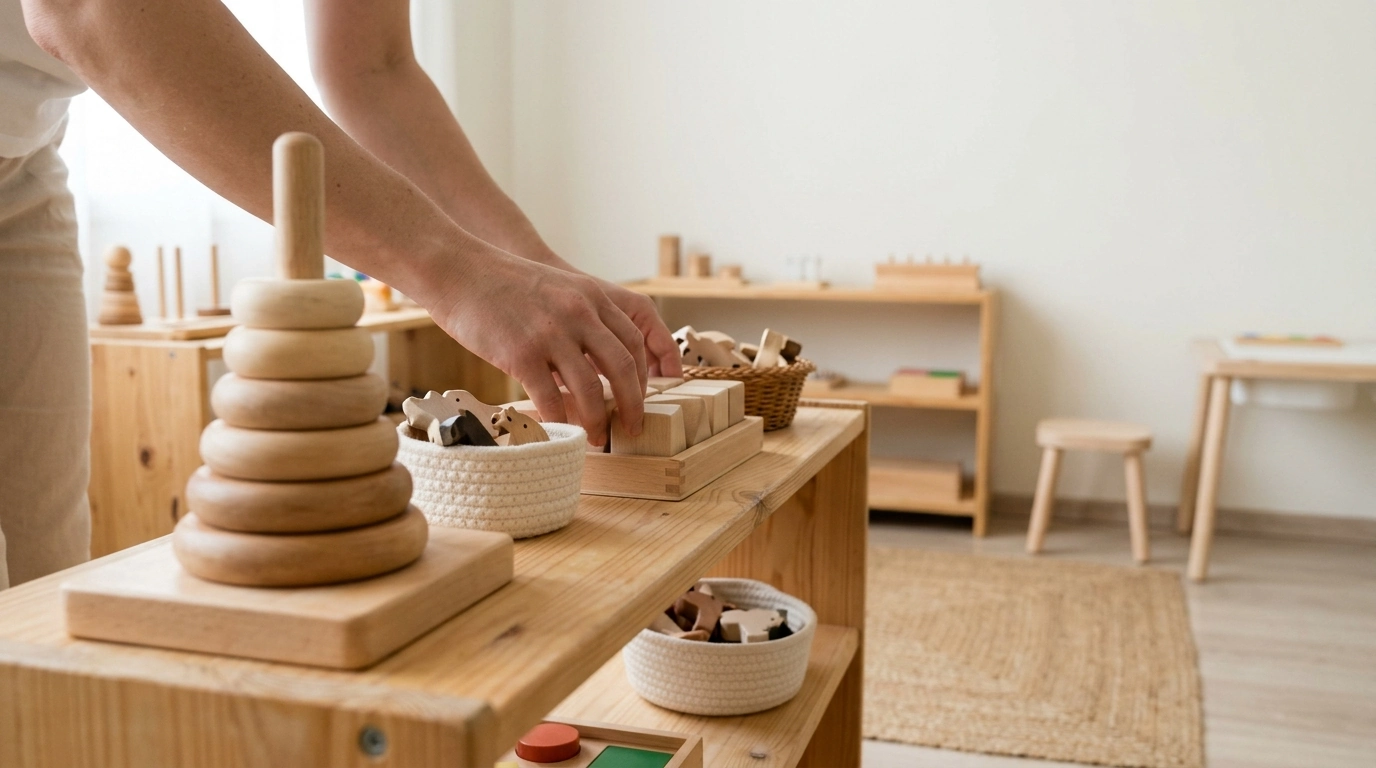
Montessori-inspired toy rotation means keeping a small, inviting selection of toys and activities within your child’s reach while storing the rest out of sight. After your child has had time to explore what’s available, you swap some items for others. The goal is not to introduce something new every day. It’s to make it easier for your child to choose an activity, use it independently, and return to it with fresh interest.
Choose a few activities that offer different kinds of play, such as building, sorting, pretend play, art, and movement. Place them on a low shelf or in accessible baskets so your child can see and reach each one. Leave enough space that taking out one activity doesn’t require moving a pile of others. Store the remaining toys where they won’t compete for attention.
Watch what your child chooses and how they use it. If they’re still returning to a puzzle or building set, you can leave it out, even when you rotate other toys. If an activity has been ignored for a while, put it away and try something different. You can also bring back a familiar favorite; rotation does not require buying new toys.
There’s no required number of toys or fixed Montessori rotation schedule. A weekly look at the shelf works for many busy families, but you can make smaller changes whenever interest shifts. Our team recommends changing only a few items at a time so the space remains familiar and your child has a chance to explore each activity fully. For a practical routine, see our simple weekly toy rotation plan.
Look for toys that match your child’s current abilities while offering a little room to grow. Open-ended materials, such as blocks, play food, or simple art supplies, can support many kinds of play. Keep small parts away from children who may put them in their mouths, and supervise activities that call for it. When you put out a toy with several pieces, give it a clear home, such as a tray or basket, to make choosing and putting it away easier.
Keep the process flexible. If a rotation sparks interest, let your child enjoy it. If it doesn’t, you can adjust the selection without treating the schedule as a rule.
No. Keep activities your child still enjoys and swap out only the ones they’ve stopped choosing. A partial rotation preserves familiar favorites while making room for something different.











Leave a comment